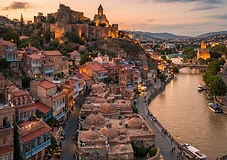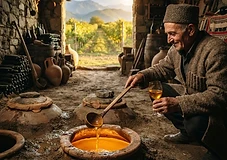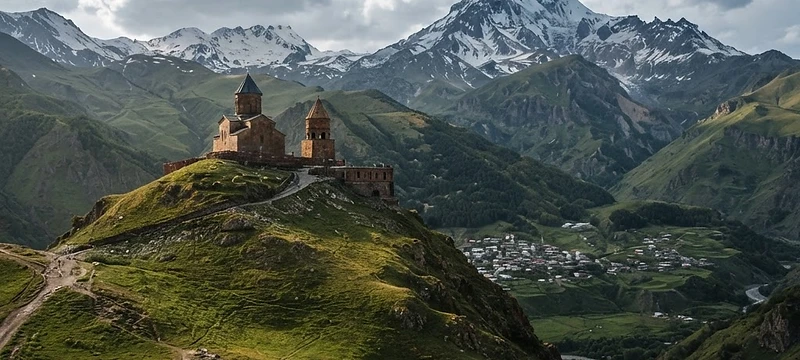
From the Greater Caucasus peaks and Black Sea coast to Prometheus Cave, 860 lakes and 55 waterfalls — discover the breathtaking natural diversity of Georgia.
Georgia: A Land Given by God
There is a Georgian legend that when God was distributing lands to people, the Georgians arrived last because they had been feasting and glorifying God. So God gave them the land He had intended to keep for Himself. Anyone who has visited Georgia can confirm the legend feels close to the truth. In this small country — just 69,700 square kilometres — you can ski in the Caucasus Mountains in the morning and swim in the Black Sea by afternoon. Few places on Earth pack so much natural diversity into such a compact area.
To the north rise the towering Greater Caucasus Mountains. To the west stretches the shimmering Black Sea coast. To the south lie the Lesser Caucasus Mountains. And to the east unfold valleys, fields, rivers, waterfalls, peaks, springs, lakes, reservoirs, forests, caves and alpine flower meadows. Georgia contains nearly every climate type that exists on Earth, from humid subtropical to permafrost glacial.
Lakes, Rivers and Waterfalls
Despite its modest size, Georgia contains an astonishing 26,060 rivers, 860 lakes, 55 waterfalls and 44 reservoirs. The Mtkvari River flows through the heart of Tbilisi, while the Aragvi, Rioni and Alazani rivers carve through mountain gorges and fertile valleys. Notable lakes include the stunning Shaori Lake, the turquoise Abudelauri Lakes high in the mountains, and the reservoir-like Tbilisi Sea just outside the capital.
Waterfall lovers will find treasures throughout the country. The Gveleti Waterfall in the Dariali Gorge cascades down basalt cliffs. The Abasha Waterfall pours through Okatse Canyon. Each region offers its own spectacular water features, many reachable by scenic hiking trails.
Underground Palaces: Georgia's Cave Systems
Georgia is rich in underground wonders. Twenty-eight caves have been discovered so far, and they are of immense interest to spelunkers and casual visitors alike.
The Prometheus Cave near Tskaltubo is a unique piece of prehistory — a vast limestone cavern with dramatic stalactites, stalagmites and underground lakes. You can walk through illuminated halls or take a boat ride on the subterranean river.
The Sataplia Cave is the only place in the world where you can see 120 million-year-old herbivorous and carnivorous dinosaur footprints preserved in stone. The cave itself is surrounded by a nature reserve with lush forest and panoramic viewpoints.
The New Athos Cave, in the Abkhazia region, is one of the longest cave systems in the world, formed from Mesozoic limestone with numerous caverns of stunning beauty.
Canyons and Natural Monuments
Georgia's landscape has been sculpted over centuries into natural monuments of breathtaking beauty. The Okatse Canyon features a suspended walkway clinging to the cliff walls, offering vertigo-inducing views of the turquoise river below. The Tsalka (Dashbashi) Canyon is one of Georgia's deepest gorges, with a glass-bottomed observation platform extending over the abyss. The Truso Valley offers otherworldly landscapes of mineral springs, travertine formations and abandoned towers against a backdrop of snow-capped peaks.
Forests, Wetlands and Wildlife
The Alazani Floodplain Forests in Kakheti are a protected natural monument of ancient trees and rich biodiversity. The unique Ispani Wetlands near Kobuleti have been part of the Georgian ecosystem since the 4th or 3rd century BCE and are the most untouched filtrating wetlands in the world, attracting scientists and nature lovers alike.
Georgia's wildlife includes Caucasian red deer, roe deer, wild boar, brown bears, wolves, lynxes and the rare Caucasian leopard. Many species found here are on the IUCN Red List and are protected within national parks and reserves. The Goderdzi Petrified Forest in Ajara is a unique natural monument where ancient trees have turned to stone over millions of years.
Plant Paradise: 4,100 Species and Counting
Georgia is one of the most biodiverse countries in the temperate zone, with over 4,100 plant species. Around 900 species are endemic — found nowhere else on Earth. The country is a centre of development for grapevines, cereals, fruits and many other cultivated varieties. In spring and summer, the mountains and meadows burst with poppies, daisies, larkspur and alpine flowers, creating landscapes of extraordinary beauty.
Best Natural Experiences by Season
- Spring (April–June): Wildflowers bloom, waterfalls are at their fullest, and hiking trails reopen.
- Summer (June–August): Ideal for high-altitude hiking in Svaneti and Tusheti, Black Sea beaches, and canyon adventures.
- Autumn (September–October): Golden landscapes, grape harvest season, and perfect hiking weather.
- Winter (December–March): Skiing in Gudauri, Bakuriani and Tetnuldi, with snow-covered mountain panoramas.
Plan Your Georgia Nature Journey
Our specialists can design a custom itinerary combining Georgia's natural wonders — from Prometheus Cave and Okatse Canyon to the Caucasus peaks of Svaneti and the Black Sea coast. Whether you seek adventure, photography or peaceful immersion in nature, Georgia delivers beyond imagination.